
The largest defibrillator database in the world
More than 400,000 defibrillators mapped, maintained and kept current. It is the asset behind the app, and it is also a service in its own right for anyone who has to look after a fleet of devices.
A defibrillator that nobody can find, or that has expired pads, is not a defibrillator. Most AED estates fail on record quality long before they fail on hardware.
Keeping the data true
- Internal artificial intelligence tools that flag improbable records and likely duplicates.
- Duplicate detection and a nearby-AED view when a new record is created.
- Fault reports submitted by the public through the app, routed to the operator.
- Tracking of every user-generated modification, with validation before it goes live.
- Bulk import and export, so an existing estate can be loaded and reconciled.
What a record holds
Monitoring and compliance
For an operator with an estate to answer for, the question is not where the defibrillators are. It is whether they were checked, when, and what happened when they were not.
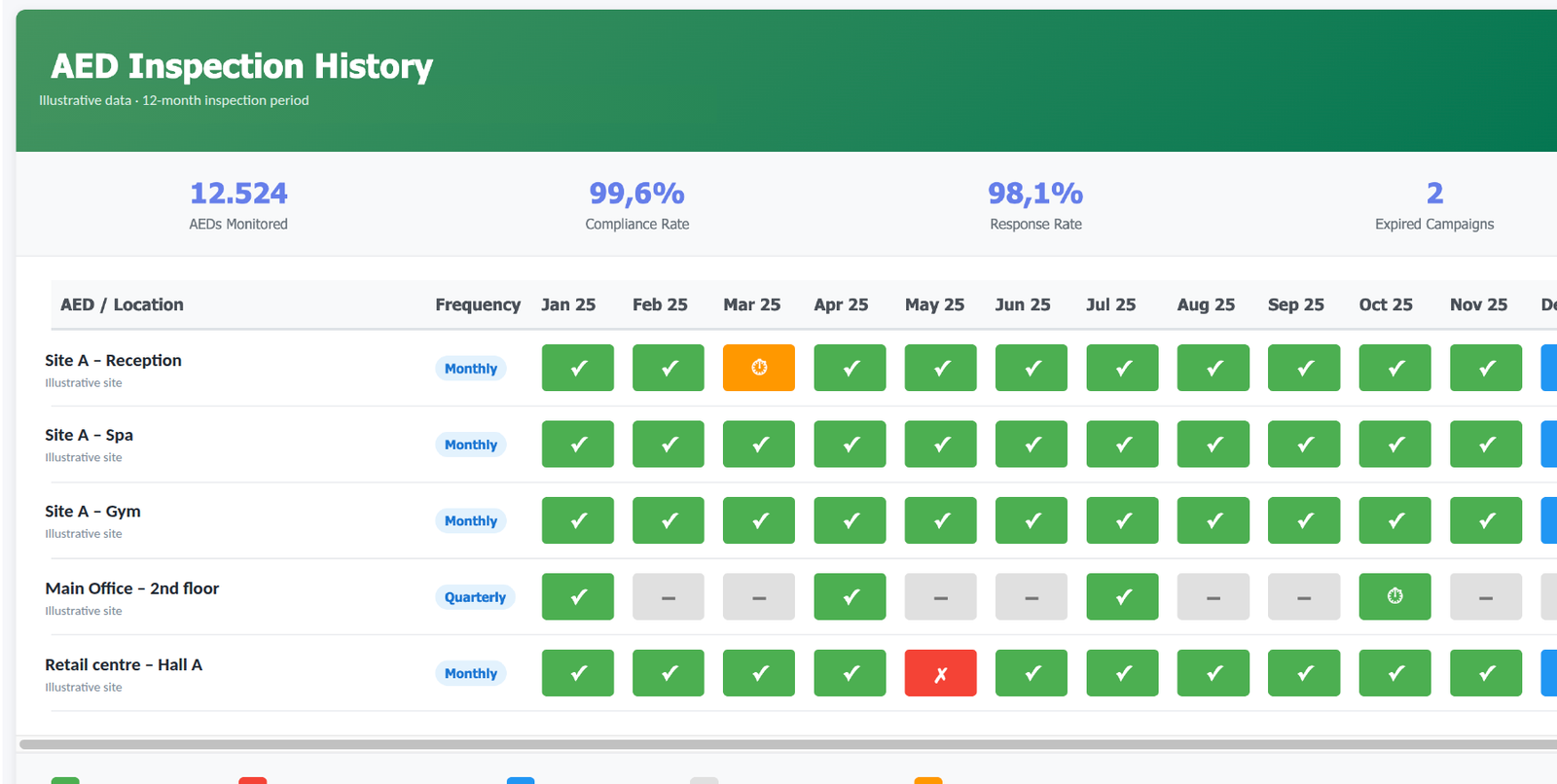
- Inspection campaigns, monthly or quarterly, per device.
- Compliance rate and response rate across the estate.
- Expired campaigns flagged, so nothing quietly lapses.
- Maintenance notifications ahead of pad and battery expiry.
- Exportable history, which is what an auditor or an insurer asks for.
Private fleets
The same tools serve a single operator with sites across several countries: a hotel group, an industrial operator, a retail network, a police force. Multi-site management, one console, one compliance report.
Publishing the data
- Customised RSS or JSON feeds to inject the database into your own information system.
- Embedded, customised maps for your website or your GIS.
- A live map usable in a dispatch room to monitor defibrillator status in real time.
- Interoperability with national registries where one exists.
GéoCœur, the connected cabinet
GéoCœur turns any existing defibrillator into a connected one. When an alert is raised nearby, the unit sets off a beacon and an audible signal so passers-by can see where the device is, and a QR code gives immediate access to its instructions. It mounts beside the existing cabinet, with no hardware to replace, and is activated by the dispatch centre through Staying Alive.
Bringing the public in
Members of the public can verify defibrillators through the app, report faults and add photos. Gamified, it turns an estate of devices into something a community maintains rather than something an operator inspects once a year.
Tell us how many devices you look after and where they are. We will show you what the estate looks like once it is under supervision.