
Around 50,000 people suffer an out-of-hospital cardiac arrest in France every year, which is one every ten minutes. In 2025, the Staying Alive app dispatched 20,042 alerts to its citizen responders.
One alert every 26 minutes
Across 2025, the network recorded 20,042 alerts, an average of 55 a day. Analysing them reveals temporal patterns that are clear and consistent.
Early morning is the critical window
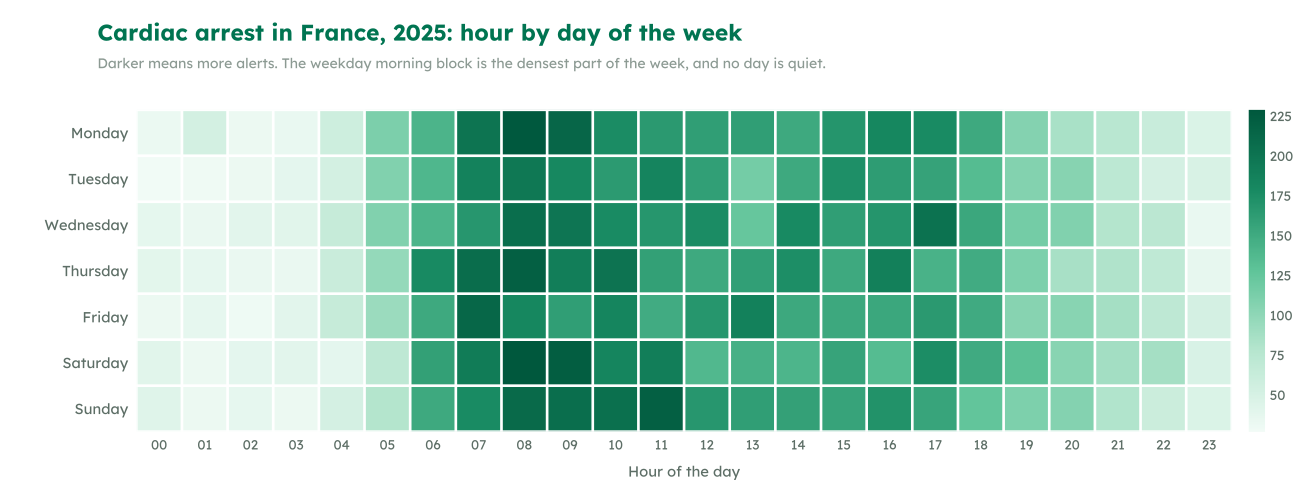
Activity peaks between 8am and 9am, with 1,436 cardiac arrests recorded in that single hour, or 7.2% of the year’s total. The climb starts early: volumes rise sharply from 5am onwards.
Winter is the high-risk season
January was the busiest month of the year with 1,994 dispatches, against 1,503 in June, a difference of 33%. December (1,950) and October (1,752) confirm the seasonal pattern.
Days of the week, by contrast, look alike
The distribution is remarkably flat, ranging from 2,732 alerts on Tuesdays to 2,911 on Wednesdays.
Why this analysis matters
In France, the survival rate after an out-of-hospital cardiac arrest remains below 10%. In Scandinavia it exceeds 25%. Bystander chest compressions are performed in only 20% to 40% of cases before the emergency services arrive.
The size of the prize has been measured. A peer-reviewed cohort study conducted with the Paris Fire Brigade and published in Academic Emergency Medicine analysed all 4,107 out-of-hospital cardiac arrests managed in Greater Paris over one year. Where a citizen responder alerted through Staying Alive reached the scene and acted, survival to hospital discharge was 35%, against 16% in the comparison group. Return of spontaneous circulation on hospital admission was 48%, against 23%. After adjustment for confounding factors, being in the citizen-responder group was associated with an adjusted odds ratio for survival of 5.9 (95% CI 2.12 to 16.54, p < 0.001).
Reference: Derkenne C, Jost D, Roquet F, Dardel P, et al. Mobile Smartphone Technology Is Associated With Out-of-hospital Cardiac Arrest Survival Improvement: The First Year “Greater Paris Fire Brigade” Experience. Academic Emergency Medicine, 2020. doi: 10.1111/acem.13987
That is the argument for citizen-responder networks in one comparison. The clinical response is well understood and inexpensive. What is missing, almost everywhere, is a system that puts a trained pair of hands next to the victim inside the first few minutes.
The network in 2025
As at 31 December 2025, the Staying Alive network counted:
– 500,000 registered and active citizen responders
– more than 2.5 million app downloads
– 400,000 defibrillators in our database
– deployment across 90 French departements and in Luxembourg
From September 2026, the network also covers the province of Luxembourg in Belgium, the region bordering both France and the Grand Duchy.
The target for 2029 is 1,000,000 citizen responders.
What the 2025 data changes
Analysing 20,042 dispatches is not an exercise in reporting. It is what allows a deployment strategy to be aimed rather than spread evenly.
Three consequences follow directly from the figures above. Under-covered areas need reinforcing at peak hours, not on average across the day, because a responder density that works at 3pm can fail at 8am. Public awareness campaigns should be weighted towards the winter months, when volumes run a third higher than in June. And recruitment should be prioritised in the territories where responder density remains too low, rather than in the areas that are already well covered and easiest to grow.
The flat weekday distribution carries a practical message of its own: there is no quiet day. A network that depends on volunteers who are only reachable on weekdays, or only outside working hours, will miss a predictable share of cases.
👉 Want to build a citizen-responder network in your country or region? Talk to us.