
How to use a defibrillator in 5 steps
Introduction
You walk past a defibrillator in a station, an airport, a town hall or a gym, and you wonder whether you would know how to use it. You would. No medical training required.
An automated external defibrillator (AED) is designed to talk any bystander through the procedure, step by step, in plain spoken instructions. In France, and in most European countries, anyone is legally allowed to use a public defibrillator on someone in cardiac arrest.
Here is how, in five steps.
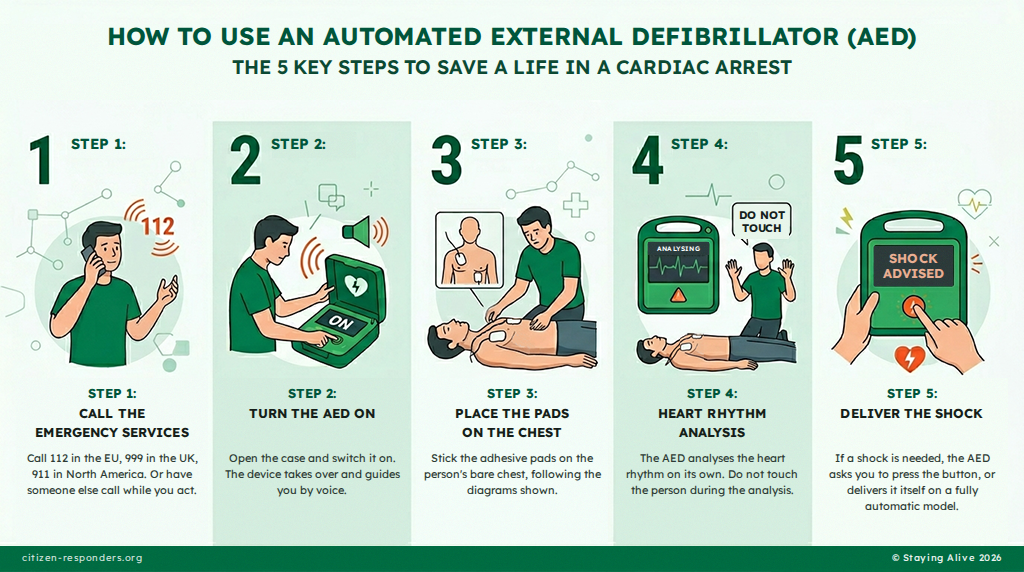
Before you start: call for help
Before using the defibrillator, or at the same time, call the emergency number (112 in the European Union, 999 in the United Kingdom, 911 in North America), or have someone else call.
While one person fetches the defibrillator, another starts chest compressions. The two happen in parallel, never one after the other.
Step 1. Turn the defibrillator on
As soon as you have the device, turn it on. Depending on the model:
- press the green power button, or
- simply open the lid. Most switch on by themselves.
It starts speaking immediately. Listen and follow what it says. It tells you exactly what to do.
Step 2. Prepare the person
For the pads to stick properly to the skin, you need to:
- bare the chest, cutting clothing if necessary;
- dry the skin if it is wet from rain or sweat;
- shave a very hairy chest. Some AEDs include a razor for this.
- remove any jewellery or medication patch, a nitroglycerin patch for instance.
Step 3. Apply the pads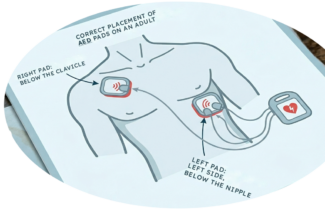
Take the two adhesive pads out of their packaging. Pictograms on the pads, and on the device itself, show exactly where they go:
- Pad 1: below the right collarbone, to the right of the breastbone.
- Pad 2: below the left breast, in line with the left armpit.
Press them firmly onto bare skin. Plug in the cables if they are not connected already. On most AEDs the pads come pre-connected.
Step 4. Let the device analyse
Once the pads are on, the AED analyses the heart rhythm by itself. During the analysis:
- do not touch the person;
- ask everyone to stand clear;
- wait for the device to tell you whether it advises a shock.
If a shock is advised, the AED charges automatically and warns you with a sound or a light.
Step 5. Deliver the shock, if advised
If the AED advises a shock:
- Check that nobody is touching the person, and say it out loud: “Everybody stand clear.”
- A fully automatic defibrillator delivers the shock on its own. On a semi-automatic model, press the flashing button.
- Resume chest compressions immediately after the shock. Do not wait.
If the AED says no shock is advised, carry on with CPR. It will prompt you to let it reanalyse every 2 minutes.
After the shock: keep going
The AED reanalyses periodically. Between analyses, continue with:
- 30 chest compressions and 2 rescue breaths, if you are trained;
- or uninterrupted chest compressions alone if you are not.
Keep going until professional responders take over, or the person starts breathing normally again.
Where to find a defibrillator
Public defibrillators are increasingly common: town halls, stations, pharmacies, shopping centres, stadiums, schools.
To find the nearest one:
- open the Staying Alive app (iOS and Android);
- Staying Alive maps more than 400,000 defibrillators, the largest such database in the world.
Conclusion
Using a defibrillator is within anyone’s reach. These five steps are enough to act effectively in the critical first minutes of a cardiac arrest.
The best way to be ready is to download the Staying Alive app and join the network of more than 500,000 citizen responders.