
Cardiac arrest: the actions that save lives
Introduction
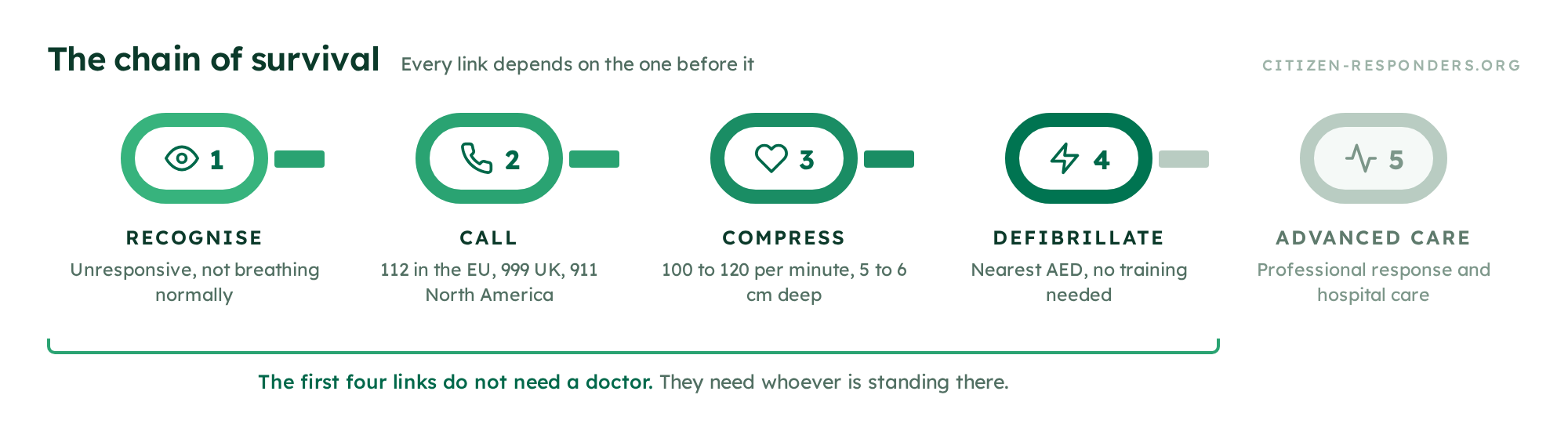
Cardiac arrest kills within minutes, and the person who decides the outcome is almost never a doctor. It is whoever is standing there. This page sets out the five things to do, in order, with no prior training assumed.
1. Recognise a cardiac arrest
Cardiac arrest is sudden. The person collapses, stops breathing normally (or takes noisy, gasping breaths known as agonal breathing) and does not respond. This is not an ordinary faint.
The signs, identified in under 10 seconds:
- The person is unresponsive: no reaction when you speak to them or shake them.
- They are not breathing normally: no chest movement, or noisy irregular gasping.
- Their face turns pale or blue-tinged.
Do not waste time looking for a pulse if you are not a health professional. Start acting.
2. Call the emergency services immediately
As soon as you suspect cardiac arrest, call or have someone call the emergency number: 112 anywhere in the European Union, 999 in the United Kingdom, 911 in North America.
Practical advice:
- If you are alone, put the phone on speaker and start chest compressions without waiting.
- If other people are present, point at one of them: “You, call 112 now.”
- Stay on the line. The dispatcher can talk you through every step.
3. Start chest compressions (CPR)
In a cardiac arrest, resuscitation has to start without delay.
Chest compressions are the single most important thing you can do. They keep blood flowing to the brain until help arrives.
How to perform chest compressions:
- Lay the person on their back on a firm surface.
- Place the heel of your hand in the centre of the chest, on the breastbone.
- Put your other hand on top and interlock your fingers.
- Push hard and fast: 5 to 6 cm deep, at a rate of 100 to 120 compressions per minute.
- Do not stop, even when you tire. Swap with someone else if you can.
If you are trained in rescue breaths, give 30 compressions to 2 breaths. If you are not trained, keep going with compressions alone. It works.
4. Use an automated external defibrillator (AED)
An automated external defibrillator is a device that can restore a normal heart rhythm by delivering an electric shock. It is designed to be used by anyone, trained or not.
More than 400,000 defibrillators are mapped in the Staying Alive database. To find the nearest one, open the Staying Alive app.
How to use an AED:
- Turn it on. It talks you through the whole sequence.
- Apply the pads to the person’s bare chest, following the diagrams on them.
- The device analyses the heart rhythm on its own.
- If it advises a shock, make sure nobody is touching the person.
- Resume chest compressions immediately after the shock.
5. Keep going until help arrives
Do not stop. Continue CPR, and let the AED reanalyse every 2 minutes, until:
- professional responders take over, or
- the person starts breathing normally again.
Anyone can save a life
Cardiac arrest gives no warning. But with the right reflexes, call, compress, defibrillate, anyone becomes a vital link in the chain of survival.
The best way to be ready is to get trained in basic life support and to join a citizen responder network.